Flour
German Flour — Type 405, 550, Spelt, Rye & Gluten-Free
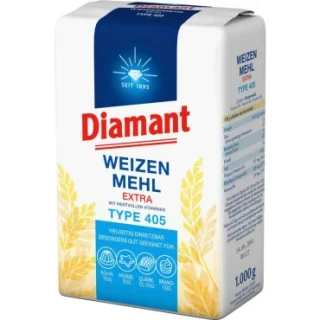
If you have ever tried to recreate a German recipe abroad, you know the flour matters. Germany uses a unique type-number system based on mineral content — and those numbers directly affect your baking results. At GermanFoods.shop, we stock authentic German flours from brands like Diamant (Germany's first registered flour brand, since 1895) and Schär (gluten-free specialists since 1922). From fine Type 405 for Kuchen to hearty Type 1050 for Mischbrot, plus spelt and rye varieties, you will find exactly the flour your recipe calls for. Shipped directly from Germany to the USA, UK, and Canada.
Understanding German Flour Types
Germany classifies flour by a type number defined under DIN standard 10355. The number indicates the mineral content (ash content) remaining after 100 grams of flour are incinerated at 900°C. Type 405, for example, leaves 405 milligrams of mineral ash — making it the most refined, whitest wheat flour available. The higher the type number, the more of the grain's bran and germ is included, resulting in darker color, stronger flavor, and higher fiber content.
This system has been in use since 1934 and was updated to the current DIN 10355 standard in 1992. It applies to wheat, spelt, and rye flours separately:
• Wheat (Weizenmehl): Type 405 (fine pastry and cakes), Type 550 (all-purpose, comparable to US AP flour), Type 812 (bread flour), Type 1050 (dark, robust breads) - Spelt (Dinkelmehl): Type 630 (fine, light), Type 1050 (heartier loaves) - Rye (Roggenmehl): Type 997 (medium), Type 1150 (standard sourdough rye), Type 1370 (dark rye)
This is fundamentally different from the American system, which grades flour by protein/gluten content. A German Type 550 and American all-purpose flour may behave similarly in many recipes, but they are classified by entirely different criteria.
Our Brands
Diamant traces its milling roots to 1775, when the Plange family operated a watermill in Hattrop near Soest, Westphalia. The Diamant brand itself was registered with the Imperial Patent Office in Berlin on July 12, 1895, making it Germany's first registered household flour brand. In 1897, the company built the largest flour mill on the European continent in Hamburg-Wilhelmsburg, positioned directly on the water to receive wheat shipments by sea. Today, Diamant offers a full range of wheat, spelt, and rye flours in the standard German type numbers.
Schär was co-founded in 1922 by Dr. Anton Schär in Meran, South Tyrol. The company pivoted to gluten-free products in the 1980s under Ulrich Ladurner, launching its first gluten-free pasta in 1985. Schär's gluten-free flour blends are specifically formulated for baking, using rice flour, corn starch, and other substitutes to replicate the texture of wheat-based products. For anyone with celiac disease or gluten sensitivity, Schär provides a reliable alternative that still works in traditional German recipes.
FAQ
What does the type number on German flour mean?
The number indicates the mineral (ash) content per 100 grams of flour, measured in milligrams. Type 405 leaves 405 mg of ash when burned — it is the finest, whitest wheat flour. Type 1050 retains 1,050 mg, meaning more bran and germ are included, producing darker, more nutritious flour. This system is defined by DIN standard 10355 and has been used in Germany since 1934.
Which German flour type replaces American all-purpose flour?
Type 550 is the closest equivalent to American all-purpose flour. It has a similar extraction rate and works well for general baking, bread, and cookies. For cakes and pastries where a finer crumb is needed, use Type 405 instead.
Do you carry gluten-free flour?
Yes. We stock gluten-free flour blends from Schär, a brand that has specialized in gluten-free products since the 1980s. Their baking flour is formulated to work in recipes that normally require wheat flour, making it suitable for those with celiac disease or gluten sensitivity.
Why does German flour produce different results than American flour?
German and American flours are classified by different criteria — Germany uses mineral content, while the US uses protein content. Even when the ash content is similar, the milling and blending processes differ. German flours are produced from specific wheat varieties and blends optimized for the German type system, which is why importing the actual flour gives the most authentic results for German recipes.